World Mental Health Day on October 10 reminds people why their mental health is important, but for college students, mental health can be an everyday struggle.
Mental health advocacy and awareness is becoming less of a taboo topic among college students and younger people with the hope that people will be more comfortable talking about their internal struggles.
According to The Huffington Post, the three main health problems among college students are anxiety, depression, and prescription drug abuse. Especially around tests and finals, students will often purchase prescription medications to help them focus in order to achieve higher grades.
“Adderall, a drug physicians use to treat ADHD, had gained popularity as a study drug because it’s a stimulant, which allows students to stay awake longer to finish their coursework. It also causes the brain to release dopamine, which makes people feel happy and enjoy their coursework,” according to the article.
Dr. Jim Clark, the Dean and a professor at the College of Social Work at Florida State University, gives his take on study drug addictions on college campuses.
“These mental health centers or Counseling Centers are crucial components of student health programs. Usually run though the Office of Student Affairs. They provide crisis management for students in psychiatric distress, but usually must refer for longer term therapy outside of campus,” he said about on-campus facilities.
When asked about people taking prescription drugs, like Adderall, when it is not prescribed to them. He did not know the exact statistics about students using it, but he did know that it’s prevalent across most schools.
“I think students who are abusing it are referred to treatment if they cannot taper off. Adderall is not physiologically addictive, but people have become habituated to using it as a study or energy tool. Most counseling centers will work with students to stop using it and replace with healthier alternatives like nutrition, sleep, exercise, and better planning,” he said.
According to the American Addiction Centers website, side effects of Adderall abuse include anxiety, doctor shopping, snorting it instead of taking it orally, having fears of not having Adderall, and spending time looking for Adderall, having benders, and recovering from it.
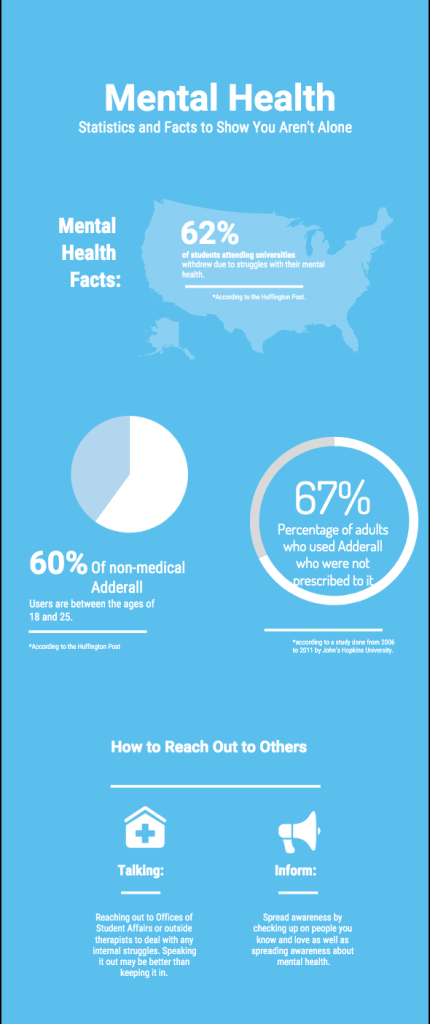
This infographic contains more information about mental health nationwide and how students are affected.
In addition to this, students who suffer from anxiety and depression sometimes find the weeks of midterms and finals harder than most days. Sacha Appel, a 21-year-old student, reached out to the DePaul Counseling Office her freshman year, but she didn’t feel she was greeted with open arms as well as underwhelming experience with the University’s student involvement office.
“I tried to go to DePaul Counseling Office freshman year when I was having a panic attack and needed something immediately, but they don’t take walk-ins. After doing some more research on the office, I learned they generally only let you have a limited number of appointments. I feel that there could be more events to do with wellness on campus for sure and OSI (Office of Student Involvement) is definitely lacking in that department,” she said about her experience.
She also stated that since the DePaul therapy offices didn’t help her as much as she thought, she since then has become a mental health advocate in her sorority as well as running for other health-related positions in DePaul Greek life.
Experiences with mental health are different for everyone, and there is always a way to get help, whether it’s within universities or not. For more information about mental health, visit the National Alliance on Mental Illness.
Related Links
https://www.womenshealth.northwestern.edu/blog/importance-promoting-mental-health-universities
 Coming Home With Katie